
Byte Trail
A downloadable game
Learn and practice Python inside a neon coding JRPG.
Write real Python, run it through ByteTrail’s validation system, and watch your terminal output transform into animated letter-beams that strike digital Bugs. Every challenge requires a working answer—but stronger craftsmanship, extra structure, and deliberately over-engineered solutions can build additional power, multipliers, dice rolls, and enormous JRPG-style combos.
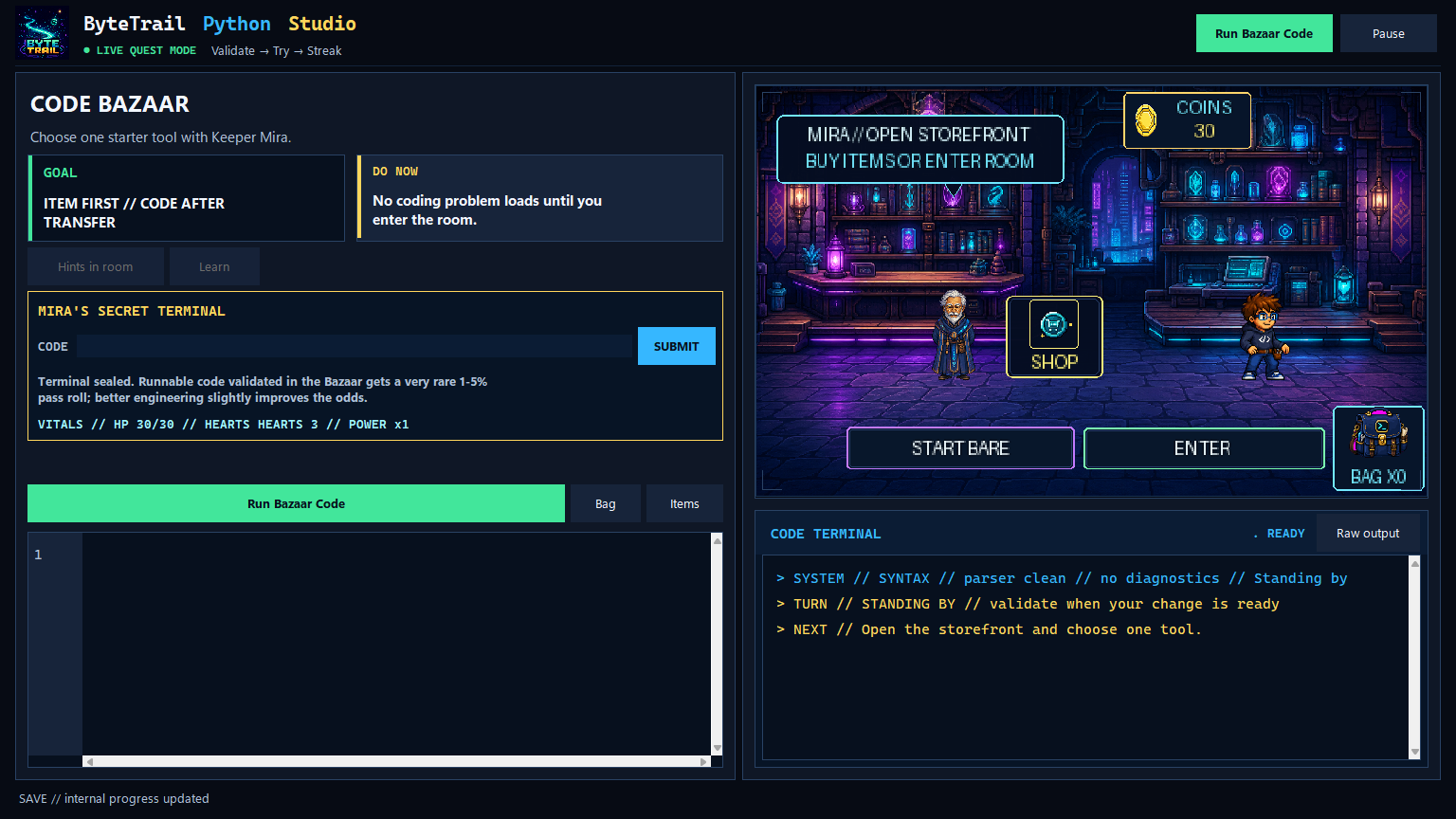
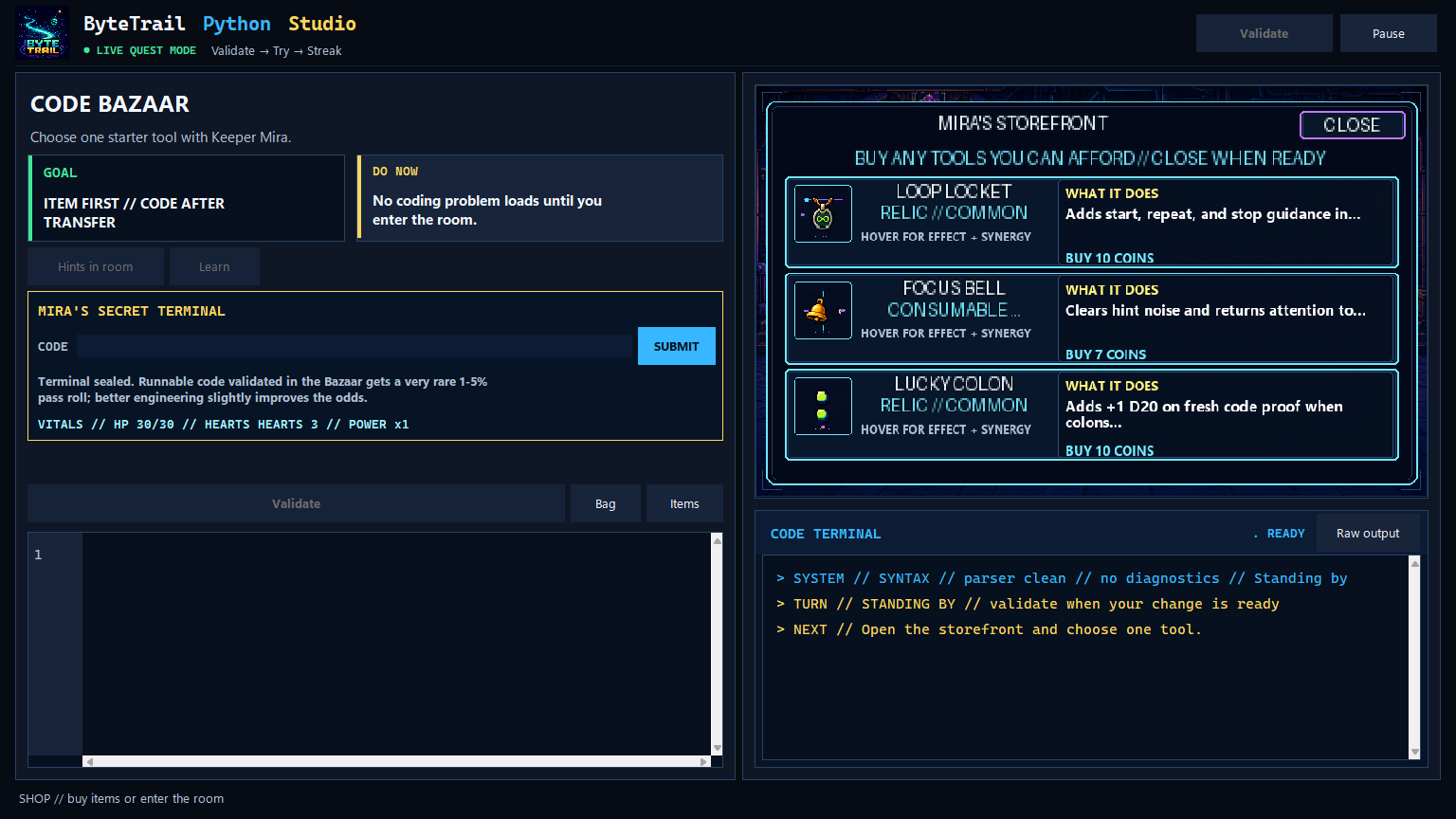
Explore procedural Easy, Medium, and Hard runs, battle multiple enemy types, face minibosses, and eventually challenge the Trojan Guardian. Between rooms, visit Mira’s Code Bazaar to purchase relics, consumables, dice, health items, Skip Tickets, and strange effects that can combine into powerful synergies.
ByteTrail turns Python practice into a neon JRPG:
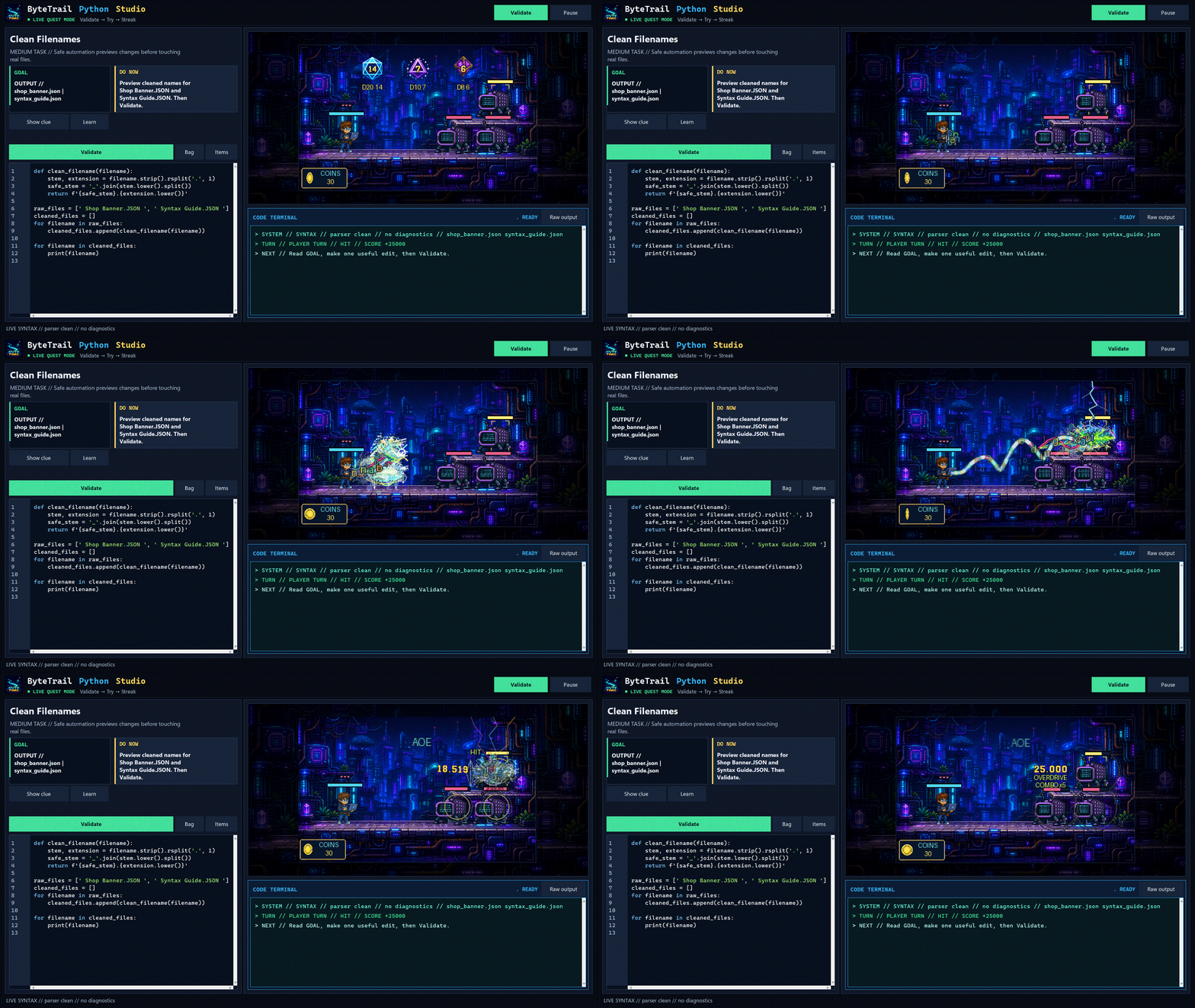
- Read the current coding objective, write Python in the editor, and press Validate.
- Correct code becomes terminal letters that fire from the player’s laptop and damage Bugs.
- Correctness is required first. More ambitious, overly engineered code can then earn additional engineering power, multipliers, combo numbers, dice effects, and stronger terminal attacks.
- Collect relics, consumables, dice, buffs, debuffs, and item synergies from Mira’s Bazaar.
- Use Skip Tickets to bypass an active room.
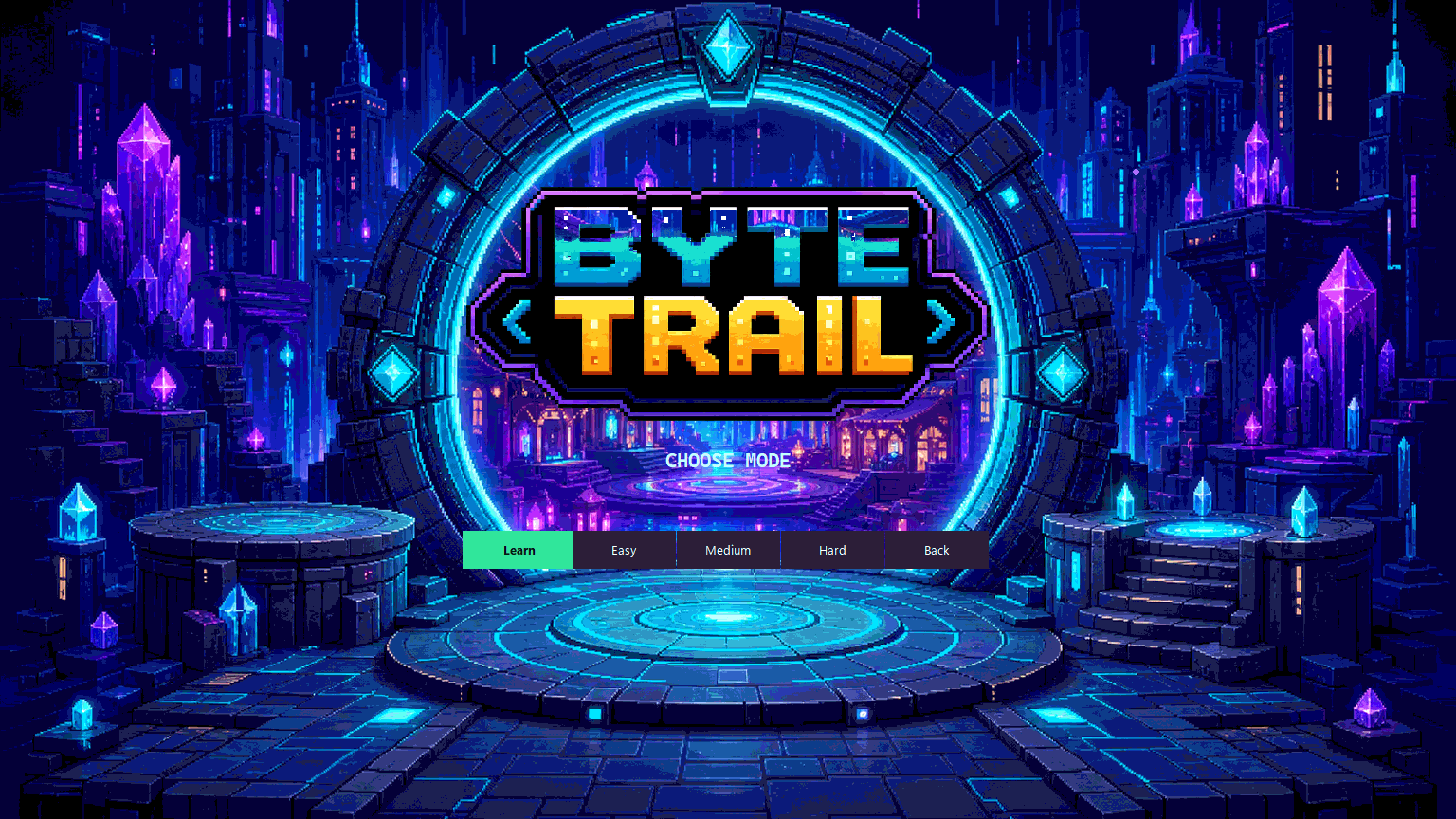
- Easy, Medium, and Hard provide procedural coding challenges, combat, minibosses, and the Trojan Guardian.
- Learn Mode is score-only robot practice without HP loss or enemy punishment.
Features:
- Real Python coding and validation
- Learn Mode with no HP penalties
- Procedural Easy, Medium, and Hard challenges
- Terminal-text beam attacks using your actual output
- 70 items with consumables, relics, curses, and dice
- 14 item synergies with distinct attack effects
- Multiple Bugs, minibosses, and the Trojan Guardian
- JRPG damage, combo, dice, health, and status systems
- Internal Save/Load system
- Original neon pixel presentation, music, and combat audio
- Endless progression after defeating the Guardian
Validation
Validation works in this order:
- Python syntax is checked.
- Code runs in a bounded workspace with a 2.5-second execution limit.
- Terminal output is compared with the mission’s required result.
- AST-based checks inspect actual Python structure—not comments or fake strings.
- Forbidden patterns are checked.
- The proven objectives become the combat result.
Easy, Medium, and Hard accept alternative valid Python if the required output is correct. Missing a preferred structure becomes an optional concept bonus instead of trapping the player.
Learn mode is stricter because it is teaching the requested concept, but it has no health penalties or enemy attacks.
A completely correct answer always lands:
- D20 controls attack strength: approximately ×0.73 through ×1.30.
- Prime D5 results—2, 3, or 5—add an excellent-hit ×1.25 bonus.
- A non-prime D5 does not cancel a correct answer.
- If enemies survive, they take their Bug Turn and another question loads.
- The room clears only after a correct answer defeats all remaining enemies.
Partial answers
Validation divides a problem into proof objectives such as:
- Required output lines
- Required code structures
- Semantic use of values
- Avoiding forbidden structures
Only newly proven objectives count. This prevents repeatedly validating unchanged partial code to farm attacks.
If more than 25% of the proof is complete:
- D20 decides the partial attack amount.
- D5 is the hit gate.
- A prime D5 makes the partial attack land.
- Typewriter Core can reroll one failed gate per room.
With very little proof, a D10 status roll occurs instead:
- Most faces create small temporary setbacks.
- Face 2 grants Second Wind.
- Faces 3 and 5 can create rescue attacks.
- Rescue attacks still need a prime D5.
Partial damage can weaken enemies but cannot finish the room’s final HP. The player must eventually submit a correct solution.
Overengineered code
Complex code earns bonuses only after it produces the correct result. Broken code, filler, comments, duplicate lines, and whitespace do not earn engineering power.
The game recognizes meaningful structures including:
- Called helper functions
- Controlled loops
- Dynamic formatting
- Assertions
- Comprehensions
- Type annotations
- Error handling
- Classes or
match - Multi-helper pipelines
- Larger legitimate control-flow structures
Engineering is capped at 12 craft points:
- Every point adds ×0.10 predictable craft power.
- At 2+ points, a Craft D6 adds ×1.10–×1.60.
- At 3+ points, an Architect D8 adds ×1.08–×1.64.
- At 5+ points, an Overengineer D12 adds ×1.08–×1.96.
- Every craft point also improves critical chance, with total critical chance capped at 40%.
- An actual critical doubles the completed attack.
Engineering becomes especially powerful with item synergies. It receives another multiplier based on craft points and the number of active synergies, capped at ×2.00.
The final attack multiplier has no global cap. Engineering, synergies, relic dice, opcodes, support effects, and criticals multiply together—this is how legitimate enormous JRPG numbers are possible.
Submitting the identical correct AST again still works, but deals only 65% damage and does not generate new craft dice. Meaningful code changes produce a new semantic signature.
Item synergies
Multiple synergies can activate simultaneously. Every additional synergy also contributes:
- A stacking multiplier up to ×1.75.
- Critical chance up to an additional 10%.
- Bug Turn reduction up to 5 damage.
Class enhancers—certain relics, legendary dice, and opcodes—can strengthen an already-active pair by +5% each, up to +15%. Enhancers cannot activate a synergy without its original pair.
Neon Fireflies, Function Forge, and Loop Locket also make landed attacks hit every living enemy. Kernel Storm temporarily provides AOE, while Bare Metal Apex grants permanent full-pack AOE with ×25 power.
Relic dice
Buying another copy adds another charge. When charges are ready, the pulsing die appears and the player clicks it deliberately. Up to eight charges roll in one sequence, one die at a time.
- Nova D4: arms ×1.25–×2 attack power.
- Guide D6: immediately restores 6–24 HP; it is unavailable at full health.
- Forge D8: arms ×1.25–×3 attack power.
- Loop D12: arms ×1.25–×4 attack power.
Attack rolls remain armed until an attack actually deals damage. Syntax failures, empty output, unchanged partial proof, and missed partial gates do not waste them. Multiple armed faces multiply together.
Legendary opcodes work through validated code placement:
combo_x2 = 2: D10 roll of 6+ activates ×2.combo_x5 = 5: D20 roll of 17+ activates ×5.combo_x10 = 10: natural D20 activates ×10.
Opcode assignments must appear exactly once and immediately before the first real action or return in the relevant function, loop, conditional, or main flow. Comments, strings, wrong values, and unrelated placement cannot spoof them. Each valid opcode rolls once per room, so failed faces cannot be farmed by repeatedly validating unchanged code.
This is the first public alpha. Feedback and bug reports are welcome.
special thank you Mazarelli & JDSherbert for the audio assets .check out their other work and the packs i used here :
https://jdsherbert.itch.io/sci-fi-ui-sfx-pack
.https://mazarelli.itch.io/cyber-latina-retro-reggaeton-mega-pack-neon-dembow
--
My first ever Game!
Thank you!
Download
Click download now to get access to the following files:
Development log
- Byte Trail - Screen shots added4 days ago
- want to have fun coding?5 days ago
Leave a comment
Log in with itch.io to leave a comment.